
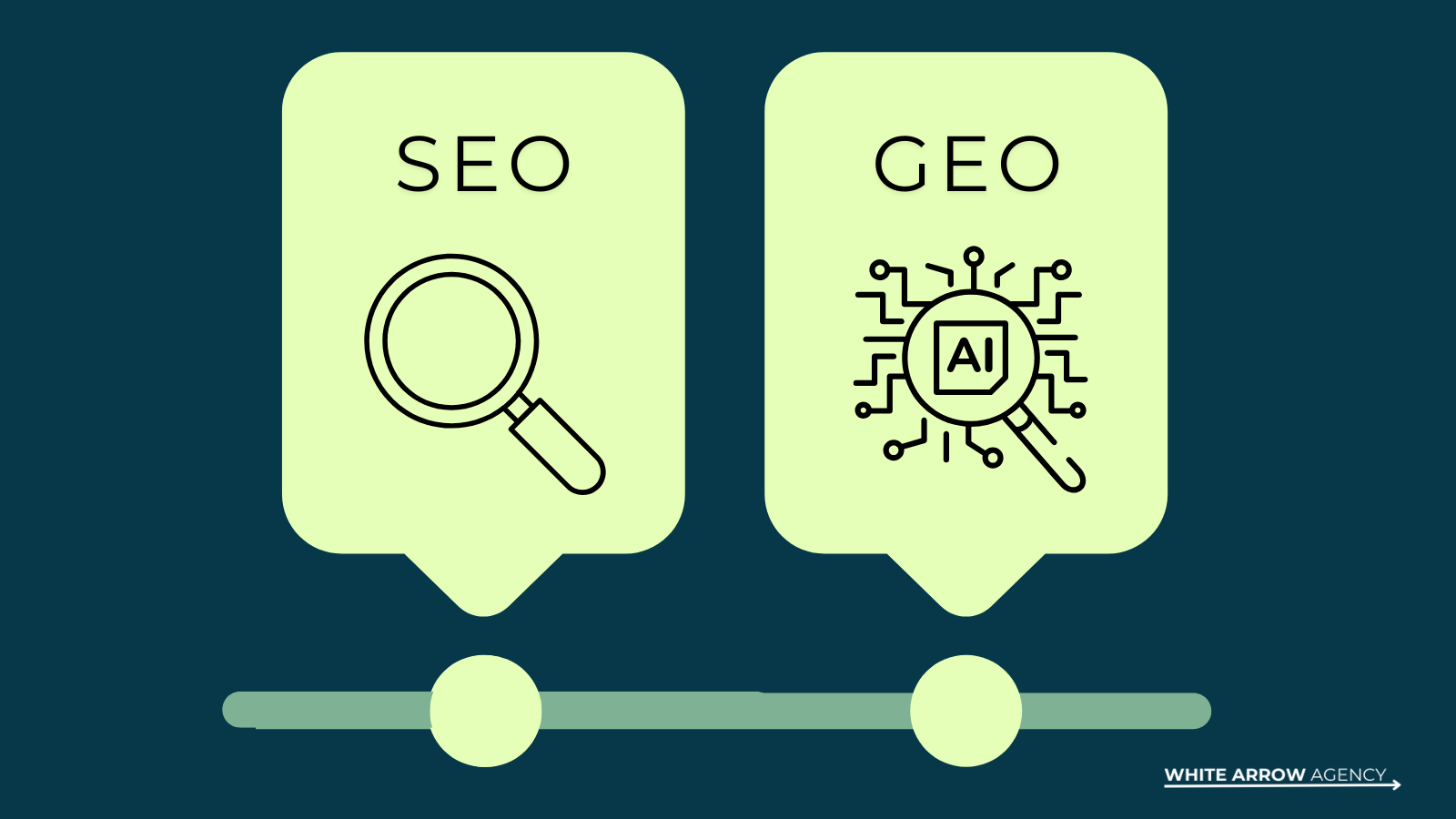
Small businesses need to be visible wherever potential customers are looking for answers. Today, that includes traditional search engines like Google and Bing, local search and maps, and increasingly, AI-powered search experiences such as Google AI Overviews, Google AI Mode, ChatGPT, and Microsoft Copilot.
That is where SEO and GEO services for small businesses come in.
Search engine optimization (SEO) helps your website appear when people search for products, services, problems, and businesses like yours. Generative Engine Optimization (GEO) focuses on making your business and content easier for AI-powered search systems to understand, retrieve, evaluate, and potentially cite in their answers.
The two strategies are closely connected. In fact, strong SEO is the foundation for effective GEO. Google says its AI search experiences continue to rely on core Search systems and established SEO best practices, while Microsoft now provides businesses with visibility into how often their content is cited in AI-generated answers.
For small businesses, the goal isn’t simply to rank for more keywords. The goal is to become visible, credible, and easy to choose when a potential customer searches for what you offer, whether that search produces a traditional result, a local listing, an AI-generated answer, or a combination of all three.
What Are SEO and GEO Services for Small Businesses?
SEO services for small businesses are strategies and implementation designed to improve a company’s visibility in traditional search results and attract qualified organic traffic.
GEO services for small businesses focus on improving the likelihood that a business’s website, expertise, products, services, and other information can be discovered and accurately represented in AI-powered search experiences.
In practical terms:
| SEO | GEO |
|---|---|
| Helps search engines understand your website | Helps AI systems understand your business and expertise |
| Targets searches and search intent | Targets questions, topics, entities, and information needs |
| Focuses heavily on rankings and organic visibility | Focuses on visibility within AI-generated answers and citations |
| Builds relevance and authority | Builds retrievability, clarity, evidence, and authority |
| Drives organic clicks and conversions | Can influence discovery, consideration, citations, and referrals |
| Includes technical, on-page, local, content, and off-page SEO | Builds on SEO while emphasizing clear, authoritative, answer-worthy content |
These aren’t competing strategies.
SEO and GEO should be treated as complementary parts of one search visibility strategy.
Google’s current guidance is especially important here: there is no separate set of technical requirements or special schema required to appear in AI Overviews or AI Mode. Pages still need to be crawlable, indexable, eligible for Search, and supported by strong SEO fundamentals.
Why the distinction matters for small businesses
A prospective customer might search:
“best HVAC company near me”
Another might ask:
“Who are the best HVAC companies in my area for replacing an old furnace?”
Another could ask:
“What should I look for when choosing an HVAC company?”
Those searches may produce very different experiences.
Your business needs to be discoverable not only for the exact keyword but also for the underlying need behind the search.
That is the fundamental opportunity created by combining SEO and GEO.
Why Small Businesses Need Both SEO and GEO
Search behavior is becoming more complex.
People still use Google to find businesses, products, services, and information. But they increasingly use AI-powered interfaces to research questions, compare options, summarize information, and narrow down decisions.
Google now provides AI Overviews and AI Mode, while Microsoft has expanded its AI Performance reporting to show businesses how their content is cited across AI-generated answers in Bing, Copilot, and related experiences.
ChatGPT can also surface public websites in its search experience. OpenAI says publishers should avoid blocking OAI-SearchBot if they want their content to be discoverable, surfaced, and cited in ChatGPT search.
That creates several good marketing opportunities for small businesses:
- Appear in traditional organic search results
- Appear in local search results
- Be discovered through maps and business listings
- Provide information used in AI-generated answers
- Earn citations from AI search experiences
- Build brand recognition before someone is ready to buy
- Capture customers researching solutions rather than just searching for businesses
The important point is that AI search does not make SEO obsolete.
Google explicitly says its generative AI search experiences are grounded in its existing Search systems and that SEO best practices remain foundational.
So rather than abandoning SEO for GEO, small businesses should build a stronger search foundation that supports both.

What Small Business SEO Services Should Include
Effective SEO is much more than adding keywords to blog posts.
A comprehensive small business SEO strategy should address the entire path from search to conversion.
1. Keyword Research and Search Intent
The first step is understanding what potential customers actually search for.
That includes:
- Primary service keywords
- Product keywords
- Local keywords
- Problem-based searches
- Informational searches
- Comparison searches
- High-intent commercial searches
- Long-tail searches
- Questions customers ask before buying
For example, a plumbing company shouldn’t focus exclusively on “plumber.”
Potential customers might also search for:
- emergency plumber
- water heater repair
- sewer line repair
- burst pipe repair
- plumber near me
- how much does water heater replacement cost
- signs I need a new water heater
- best plumber for sewer line replacement
The best SEO strategy connects these searches to the actual services and expertise of the business.
2. On-Page SEO
Every important page should make its subject immediately clear to both users and search engines.
On-page SEO can include:
- Page titles
- H1 and H2 headings
- Search intent alignment
- Natural keyword usage
- Descriptive URLs
- Internal links
- Image optimization
- Meta descriptions
- Clear calls to action
- Useful supporting content
The objective isn’t keyword stuffing.
It is clarity and relevance.
3. Technical SEO
Technical SEO ensures search engines can efficiently access, understand, and index the website.
Important areas can include:
- Crawlability
- Indexability
- XML sitemaps
- Canonical URLs
- Site architecture
- Internal linking
- Mobile usability
- Page experience
- Site speed
- HTTPS
- Redirects
- Duplicate content
- Structured data
- JavaScript rendering
Google’s AI-search guidance reinforces this point: pages need to meet the same fundamental technical requirements for Search in order to be eligible for supporting links in AI experiences.
4. Local SEO
For businesses serving a geographic market, local SEO is essential.
A local SEO strategy can include:
- Google Business Profile optimization
- Bing Places optimization
- Accurate business information
- Local landing pages
- Location-specific service pages
- Reviews and reputation signals
- Local citations
- Relevant local links
- Local content
- Consistent name, address, and phone information
This matters for AI search, too.
Microsoft specifically recommends that local businesses maintain accurate information through Bing Places because business details such as location and hours can be relevant when AI experiences generate location-based answers.
5. Content Strategy
Good SEO content should answer questions your customers actually have.
That might include:
- Service guides
- How-to articles
- Buying guides
- Comparison pages
- FAQs
- Industry insights
- Cost guides
- Troubleshooting resources
- Case studies
- Original research
- Expert commentary
But creating dozens of thin articles simply because they contain different keywords isn’t a sustainable strategy.
Google’s current guidance emphasizes original, useful, people-first content and specifically warns against producing large amounts of content primarily to manipulate rankings or AI responses.
What Small Business GEO Services Should Include
GEO is still an evolving discipline, and no legitimate agency can guarantee that a particular AI system will cite a specific business for a specific prompt.
Instead, effective GEO focuses on making your business easy for AI systems to discover, understand, verify, and reference.
1. Clear Business and Entity Information
AI systems need to understand what your business is, what you offer, where you operate, and what makes you different.
Your website should clearly communicate:
- Business name
- Services
- Products
- Locations
- Service areas
- Industries served
- Areas of expertise
- People and experts
- Credentials
- Experience
- Differentiators
- Contact information
Ambiguous or generic website copy makes this harder.
2. Answer-Focused Content
AI search systems frequently respond to questions rather than traditional keyword queries.
Your website should therefore answer questions such as:
- What does this service include?
- How does it work?
- How much does it cost?
- Who needs it?
- What are the alternatives?
- What should customers look for?
- What problems does it solve?
- How long does it take?
- When should someone hire a professional?
- How does your company compare with alternatives?
This doesn’t mean turning every page into an FAQ.
It means anticipating the information customers need to make decisions.
3. Demonstrated Expertise
Generic information is easy to reproduce.
First-hand knowledge is harder to replace.
Google’s guidance for generative AI search specifically recommends creating unique, valuable content based on genuine expertise and first-hand experience rather than simply summarizing information already available online.
For a small business, that could mean:
- Explaining how you approach a common problem
- Sharing original examples
- Discussing lessons learned
- Providing real case studies
- Publishing proprietary research
- Explaining industry-specific considerations
- Including expert commentary
- Showing actual work
This is one of the biggest opportunities small businesses have.
You don’t need to out-publish huge websites.
You need to provide information they can’t easily replicate.
4. Evidence and Supporting Sources
Claims become more credible when they’re supported by evidence.
Depending on the subject, that might include:
- Government sources
- Industry associations
- Academic research
- Original research
- Statistics
- Customer data
- Case studies
- Expert sources
For AI visibility, this can help make a page more useful as a source because it gives the content context and evidence rather than unsupported assertions.
Microsoft’s guidance for improving AI visibility specifically recommends supporting claims with evidence, examples, and cited sources.
5. Consistent Information Across the Web
Your website shouldn’t tell one story while other authoritative sources tell another.
Important business information should be reasonably consistent across:
- Your website
- Google Business Profile
- Bing Places
- Industry directories
- Professional organizations
- Social profiles
- Review platforms
- Relevant publications
- Other authoritative third-party websites
This helps establish a clearer picture of the business and its expertise.

How to Optimize a Small Business Website for AI Search
The most effective approach isn’t to try to “trick” AI systems.
It is to make your website exceptionally useful and easy to understand.
Here is a practical framework.
Make the answer obvious
Don’t bury the answer beneath five paragraphs of introduction.
When someone asks a question, answer it clearly and then explain the reasoning.
Organize information logically
Use descriptive headings, short sections, lists, tables, and other structures that make information easy to navigate.
Microsoft specifically recommends clear headings, tables, and FAQ sections as ways to improve clarity and make content easier for AI systems to reference accurately.
Provide depth behind concise answers
A short answer may help a searcher quickly understand something.
Supporting detail establishes expertise.
The ideal page does both.
Use natural language
Don’t write:
best small business SEO services SEO agency SEO consultant SEO company
Write naturally about the subject.
Modern search systems are designed to understand concepts, relationships, and intent rather than relying solely on exact keyword matching.
Build topical authority
Instead of publishing one article about a topic and moving on, develop a useful collection of related resources.
For example, a home services company might create content around:
- Home maintenance
- Emergency repairs
- Costs
- Service comparisons
- Seasonal issues
- Troubleshooting
- Product selection
Then connect those resources with internal links.
Keep important information in text
Google recommends making important content available in textual form so that it can be understood by search systems.
Don’t put essential information exclusively inside an image, video, PDF, or interactive element.
How to Get Your Small Business Cited by AI
One of the most common GEO questions is:
“How do I get my business cited by ChatGPT or another AI search engine?”
There is no guaranteed formula.
AI systems determine which sources to retrieve and cite based on many signals, and those systems change over time.
However, businesses can improve their chances by building content that is:
- Relevant to the question
- Accurate
- Clearly written
- Specific
- Authoritative
- Well-supported
- Easy to crawl and retrieve
- Consistent with other trustworthy information
- More useful than generic alternatives
Think about it this way:
AI systems need sources they can trust to answer questions.
Your job is to make your website one of those sources.
Microsoft’s AI Performance tools now let site owners see which pages are being cited in supported AI experiences and which query themes are associated with those citations.
That makes AI visibility increasingly measurable rather than purely theoretical.
SEO vs. AEO vs. GEO vs. AIO
You may also encounter several other terms when researching search optimization.
SEO: Search Engine Optimization
SEO is the broad discipline of improving a website’s visibility in search engines.
AEO: Answer Engine Optimization
AEO generally refers to optimizing content so it can provide direct answers to questions, including featured snippets and other answer-oriented search experiences.
GEO: Generative Engine Optimization
GEO focuses on visibility within generative AI experiences, including whether content is retrieved, referenced, summarized, or cited in AI-generated answers.
AIO: AI Optimization
AIO is a broader and less standardized term that can refer to optimizing digital content and entities for AI-powered discovery and experiences.
The terminology is still evolving.
More importantly, you don’t need four completely separate marketing strategies.
A strong foundation of technical SEO, useful content, authority, clear business information, and good user experience supports all of them.
Google’s current guidance makes this particularly clear: the same SEO fundamentals that help websites succeed in traditional Search remain foundational for generative AI search.
Local SEO and GEO for Small Businesses
Local businesses have an especially interesting opportunity because customers often want recommendations rather than merely information.
Consider a search such as:
“Who are the best family dentists near me?”
The customer may:
- Search Google
- Look at map results
- Read reviews
- Visit several websites
- Ask an AI assistant for recommendations
- Compare prices and services
- Contact a business
Your marketing strategy needs to support that entire journey.
That means optimizing both your website and your broader online presence.
For local businesses, make sure AI and search systems can clearly understand:
- What you do
- Where you are
- Which locations you serve
- Which services you provide
- Who you serve
- What makes you different
- What customers say about you
- Why you’re qualified
- How to contact you
Accurate local business information is particularly important because AI-generated answers can incorporate location-specific information. Microsoft recommends maintaining current information through Bing Places for Business for this reason.
A Practical 90-Day SEO and GEO Strategy for a Small Business
You don’t need to overhaul everything at once.
A focused 90-day strategy can establish a strong foundation.
Days 1–30: Build the Foundation
Start with:
- Technical SEO audit
- Keyword and search-intent research
- Competitor analysis
- Google Business Profile review
- Bing Places review
- Website architecture
- Internal linking
- Core service pages
- Location pages where appropriate
- Indexing and crawlability
- Analytics and Search Console
- Business/entity information
The goal is to make sure search engines and AI systems can clearly understand who you are, what you offer, and who you serve.
Days 31–60: Build Authority
Next, create or improve:
- High-value service pages
- Customer-focused educational content
- FAQs
- Buying guides
- Comparison content
- Case studies
- Original insights
- Expert content
- Relevant internal links
Focus on quality rather than publishing as many pages as possible.
Google specifically recommends valuable, non-commodity content and warns against creating large amounts of content primarily to manipulate rankings or AI responses.
Days 61–90: Optimize and Measure
Then evaluate:
- Organic rankings
- Organic traffic
- Search impressions
- Click-through rates
- Leads
- Calls
- Form submissions
- Conversions
- Local visibility
- Branded searches
- AI citations where measurable
Bing’s AI Performance reporting can provide additional insight into AI citations, cited pages, grounding queries, topics, intents, and citation share.
The goal isn’t simply more traffic.
It’s more qualified visibility that produces business results.

How Much Do SEO and GEO Services Cost for Small Businesses?
The cost of SEO and GEO services varies considerably depending on the business.
A small local service business with one location may need a very different strategy from a regional company with multiple locations, hundreds of services, or a competitive national market.
Factors that affect cost include:
- Competition
- Geographic market
- Number of services
- Website size
- Technical complexity
- Existing authority
- Content requirements
- Local SEO requirements
- Number of locations
- Current rankings
- Amount of implementation required
Be cautious of agencies that promise a specific Google ranking or guaranteed AI citations.
Search engines and AI systems control their results, and no legitimate SEO or GEO provider can guarantee that a business will rank #1 or be cited for a particular query.
A better provider should be able to explain:
- What they’re going to do
- Why they’re doing it
- What opportunities they identified
- How progress will be measured
- What business outcomes matter
- What is and isn’t within their control
Should a Small Business Hire an SEO/GEO Agency or Do It In-House?
It depends on your resources, expertise, and goals.
In-house SEO and GEO may make sense when:
- Someone on your team has strong SEO knowledge
- You have time to implement recommendations
- Your website is relatively simple
- Competition is manageable
- You can consistently create expert content
Hiring an SEO/GEO consultant or agency may make sense when:
- Organic search is important to growth
- Your team lacks specialized SEO expertise
- Your website has technical issues
- You aren’t sure what to prioritize
- Competitors consistently outrank you
- You need ongoing content strategy
- Local search drives leads
- You want to improve visibility across both traditional and AI-powered search
The best relationship isn’t necessarily the one with the longest list of deliverables.
It is the one that identifies the highest-value opportunities and actually improves your visibility and conversions.
How to Choose SEO and GEO Services for Your Small Business
Before hiring an SEO or GEO provider, ask these questions.
1. Do they understand my industry?
SEO strategy varies substantially by industry.
A local medical practice, ecommerce company, home services business, SaaS company, and professional services firm may all require different approaches.
2. Do they focus on business outcomes?
Rankings are useful, but they aren’t the final goal.
Ask how the provider connects SEO to:
- Leads
- Sales
- Revenue
- Calls
- Appointments
- Purchases
- Customer acquisition
3. Will they explain what they’re doing?
You should understand the strategy.
Be wary of providers who hide behind vague language about “SEO magic” or refuse to explain their recommendations.
4. Do they understand AI search?
Ask how they approach:
- AI Overviews
- AI Mode
- ChatGPT search
- Microsoft Copilot
- AI citations
- Entity clarity
- First-hand expertise
- Content structure
But be equally cautious of anyone selling a supposed “AI ranking hack.”
Google’s own guidance emphasizes that strong SEO and valuable content remain foundational rather than recommending a collection of special GEO tricks.
5. Will they prioritize?
You don’t need 100 recommendations.
You need to know which five things are most likely to make a meaningful difference.
Frequently Asked Questions About SEO and GEO Services for Small Businesses
What are SEO and GEO services?
SEO and GEO services help businesses improve their visibility across traditional search engines and AI-powered search experiences. SEO focuses primarily on search engine visibility, while GEO focuses on helping content and business information become easier for generative AI systems to discover, understand, retrieve, and potentially cite.
Is GEO the same as SEO?
No, but the two overlap significantly. GEO builds on many of the same foundations as SEO, including crawlability, useful content, authority, clear site structure, and relevance. Google says its AI search experiences continue to rely on established SEO and Search fundamentals.
Does GEO replace SEO?
No. For small businesses, SEO should remain the foundation of the search strategy. Strong SEO makes a website easier for search engines and AI-powered search systems to discover and understand.
How can a small business appear in ChatGPT?
Public websites can appear in ChatGPT search. OpenAI recommends allowing OAI-SearchBot to crawl your website if you want your content to be discoverable, surfaced, and cited in ChatGPT search.
Beyond crawlability, businesses should publish useful, accurate, authoritative information that directly addresses customer questions and clearly explains the company’s services, expertise, and differentiators.
How can I get my business cited by AI?
There is no guaranteed method for earning an AI citation. The strongest approach is to create relevant, authoritative, well-structured content supported by evidence and genuine expertise, while making sure your site is technically accessible to search and AI crawlers.
Does local SEO matter for GEO?
Yes. AI-powered search experiences can use location and business information when answering local questions. Accurate business details, service areas, locations, and other local signals therefore remain important for businesses serving specific geographic markets.
How long does SEO take for a small business?
SEO results vary based on competition, website quality, authority, market size, and the amount of work being implemented. Some technical or on-page improvements can produce relatively quick changes, while building meaningful organic authority typically takes longer.
A good SEO strategy should therefore be evaluated over time rather than based on a promise of instant rankings.
How long does GEO take?
GEO does not have a predictable timeline because AI systems continually change how they retrieve and present information.
The most sustainable approach is to build the underlying assets that support visibility: technically sound pages, useful content, authoritative information, strong business/entity signals, and a credible online presence.
Do small businesses need both SEO and GEO?
For many businesses, yes.
SEO remains essential for traditional search visibility, while GEO can help businesses prepare for customers who increasingly use AI-powered search and answer experiences during the discovery and research process.
Is AI-generated content good for SEO?
AI can be useful for research, brainstorming, organization, and other parts of the content process. But simply generating large quantities of generic content is not a sound SEO strategy.
Google emphasizes accuracy, quality, relevance, originality, and user value and warns against scaled content created primarily to manipulate search rankings.
What is the most important part of an SEO and GEO strategy?
Start with the customer.
Understand what your audience needs, what questions they ask, what problems they’re trying to solve, and what information they need before choosing a provider.
Then build the technical foundation, content, authority, and business information necessary to answer those needs better than competing sources.
SEO and GEO Are Becoming One Search Visibility Strategy
Search is changing, but the fundamental objective hasn’t changed.
Help the right people find the right information at the right time.
Traditional search may produce a list of links.
Local search may produce a map and business listings.
AI search may produce a synthesized answer with citations.
But behind all of these experiences, search systems still need to discover, interpret, evaluate, and retrieve useful information.
That is why the strongest small business strategy isn’t to chase every new acronym or AI-search trick.
It is to build a website and online presence that are:
- Technically accessible
- Relevant to customer needs
- Easy to understand
- Rich in useful information
- Supported by evidence
- Grounded in real expertise
- Consistent across the web
- Structured logically
- Regularly maintained
- Built to convert visitors into customers
Google’s current guidance for generative AI search reinforces this approach: continue investing in SEO fundamentals while creating unique, valuable, people-first content rather than chasing supposed GEO hacks.
At the same time, the emergence of AI-specific visibility measurement, including Microsoft’s AI Performance reporting, shows that visibility is expanding beyond traditional rankings and clicks toward citations and participation in AI-generated answers.
For small businesses, that creates an opportunity.
You don’t have to compete with every website on the internet.
You need to become the clearest, most useful, most credible source for the customers you want to reach.
Need Help With SEO and GEO?
White Arrow Agency helps businesses develop practical, data-driven marketing strategies designed to improve visibility, attract qualified prospects, and turn more of that attention into revenue.
If your business needs help determining what to prioritize across SEO, content, local search, AI search, and conversion optimization, contact White Arrow Agency to discuss your goals.
Leave a Reply